09 June 2026 | Story: Lyndon Julius. Photos: Supplied by d-school Afrika
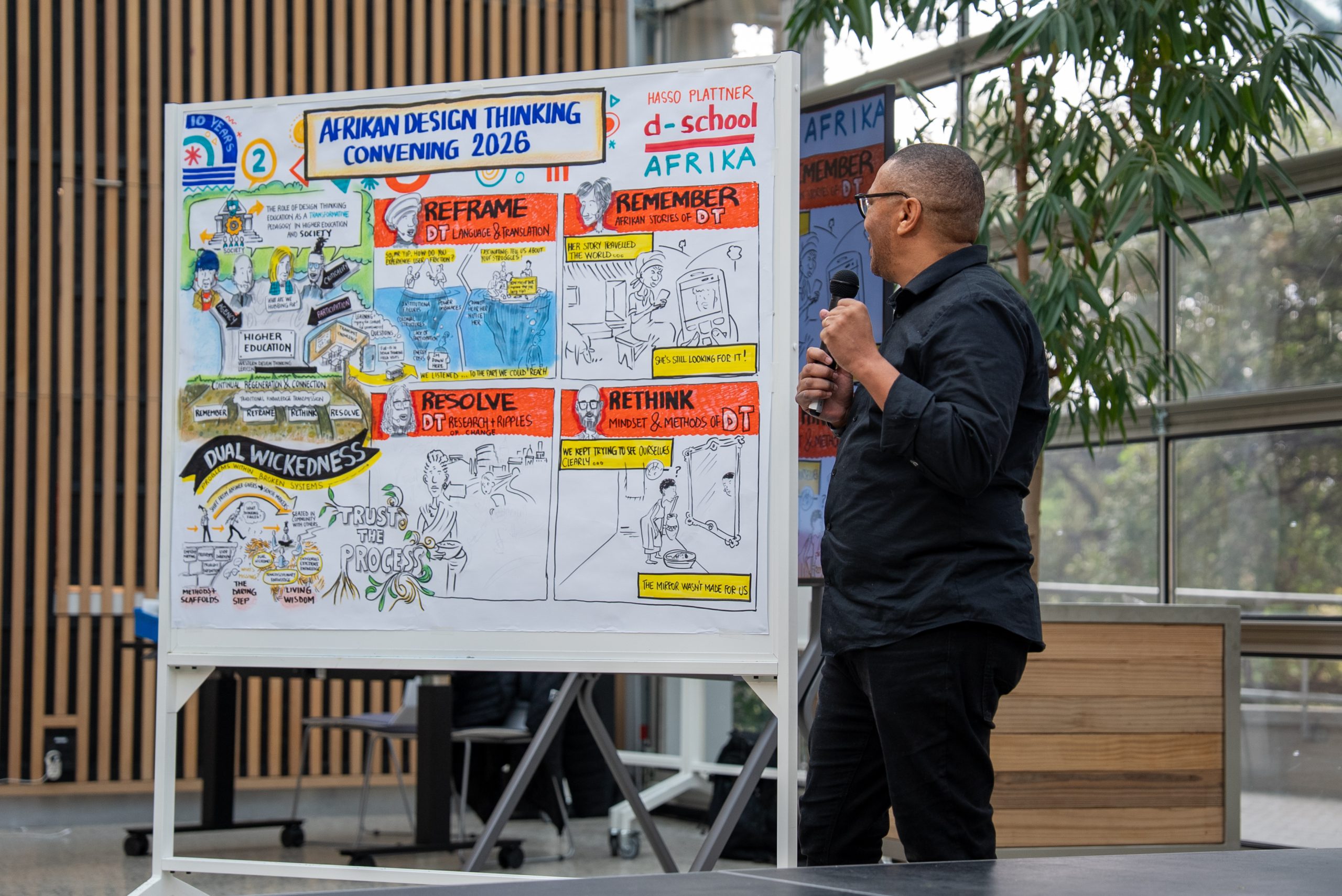
In 2026, the Hasso Plattner School of Design Thinking Afrika (d-school Afrika) at the University of Cape Town marked its tenth anniversary, celebrating a decade of fostering innovation, collaboration and human-centered problem-solving across the continent. The school is one of only three Hasso Plattner design thinking schools globally, alongside institutions in Germany, South Africa, and the United States, and has established itself as a leading hub for design thinking education and practice in Africa.
At the Hasso Plattner School of Design Thinking Afrika – better known as the d-school Afrika – design-led thinking is more than a methodology; it is a mindset that centres empathy, experimentation, collaboration, and purposeful reflection. Across disciplines and professional backgrounds, students and practitioners come together to explore complex challenges and build creative confidence in navigating uncertainty.
As Director Richard Perez explains, the d-school exists “to unlock people’s natural creativity as human beings” and to prepare graduates to thrive in a rapidly changing world. Founded on the belief that design is too important to be left only to designers, the school creates learning environments where students from diverse academic and professional backgrounds develop the critical graduate attributes demanded globally today: creative problem-solving, collaborative intelligence, critical and human-centered thinking.
“We’re not trying to turn you into a designer,” Perez emphasises. “We want you to see the world through a design lens and build confidence in solving challenges creatively.”
A meeting point between the university and society
The d-school’s physical location—on the edge of UCT’s middle campus—and its philosophical positioning at the intersection of research, teaching, industry, and community mirror its purpose as a bridge between the university and the world it serves. The building offers programmes and space for critical and creative thinking, a purpose-designed learning environment generously funded by the Hasso Plattner Foundation.
Associate Professor Janice McMillan (Head of Academics at the d-school), a sociologist with decades of experience in community-engaged scholarship, emphasises that the d-school must remain contextually grounded and responsive. Her work focuses on ensuring that research meaningfully informs programmes and that project partners become co-creators rather than subjects. “Design thinking connects the university with society,” she notes. “Relationships are at the centre of this work. If we want meaningful impact, we have to build long-term, equitable partnerships.”
African design thinking, African narratives
For Jenni van Niekerk, who leads the African Design Thinking Collaboration Network, the work extends beyond UCT to reframe design thinking within African contexts. “Africa is full of possibilities and existing innovations,” she says. The network documents African design stories, builds multilingual glossaries, and collaborates with universities across the continent to develop resources “made in Africa, for Africa.” The aim, she adds, is simple: “African solutions for African problems, built from our own knowledge systems.”
Teaching that transforms – a closer look at the student experience
While the d-school works with professionals, students remain at the heart of its mission—a point strongly echoed by Programme Lead Gadija Peterson, whose own journey began as a student in the Foundation Programme in Design Thinking.
Gadija describes her first experience as “fun, energising, and unexpectedly transformative,” recalling how teamwork revealed new forms of creativity and collaboration she had never experienced before.
“You come to the d-school, and you ‘play’ for eight hours,” she says, “but by the time you get home you realise you’ve activated parts of your brain you didn’t even know you had.”
Now, part of the team designing and leading a number of student programmes, she sees firsthand how these learning experiences shape student growth, often influencing their academic pathways or inspiring entirely new directions.
Student feedback, through daily check-ins, surveys, and debriefs, continuously refines the programmes. “The mindsets matter most,” she explains. “One conversation at a time, embracing iteration, those practices change how students show up in teams and how they approach problems in their lives.”
Her reflections ground the d-school’s purpose: to cultivate students who not only understand complexity but have the confidence, empathy, and creative agency to respond to it.
Industry partnerships with purpose
Industry engagement forms another pillar of the d-school’s ecosystem. Etienne Mostert, Business Development and Partnerships Manager, describes the team not as problem-solvers but as “process facilitators” who work with organisations as project partners – bringing real-world challenges into design-led learning contexts. “It’s about understanding the problem differently,” he explains. “We help organisations reconnect with the people they serve and create more human-centered solutions.”
These engagements range from strategic, challenge-led collaborations with organisations to climate-focused work with UCT research units – each reinforcing the school’s commitment to learning through real-world impact.
A long-term project for systemic impact
Looking ahead, Perez sees the d-school as a 20-, 30-, even 40-year institutional project. “Inside UCT, we want to influence curriculum and pedagogy,” he says. “Outside, we want to see people leading differently and creating impact within their spheres of influence.”
Ultimately, the d-school’s value lies in its commitment to co-creation, human-centered design, and African-led innovation; a rare space where academia, industry, and society come together to imagine better futures.